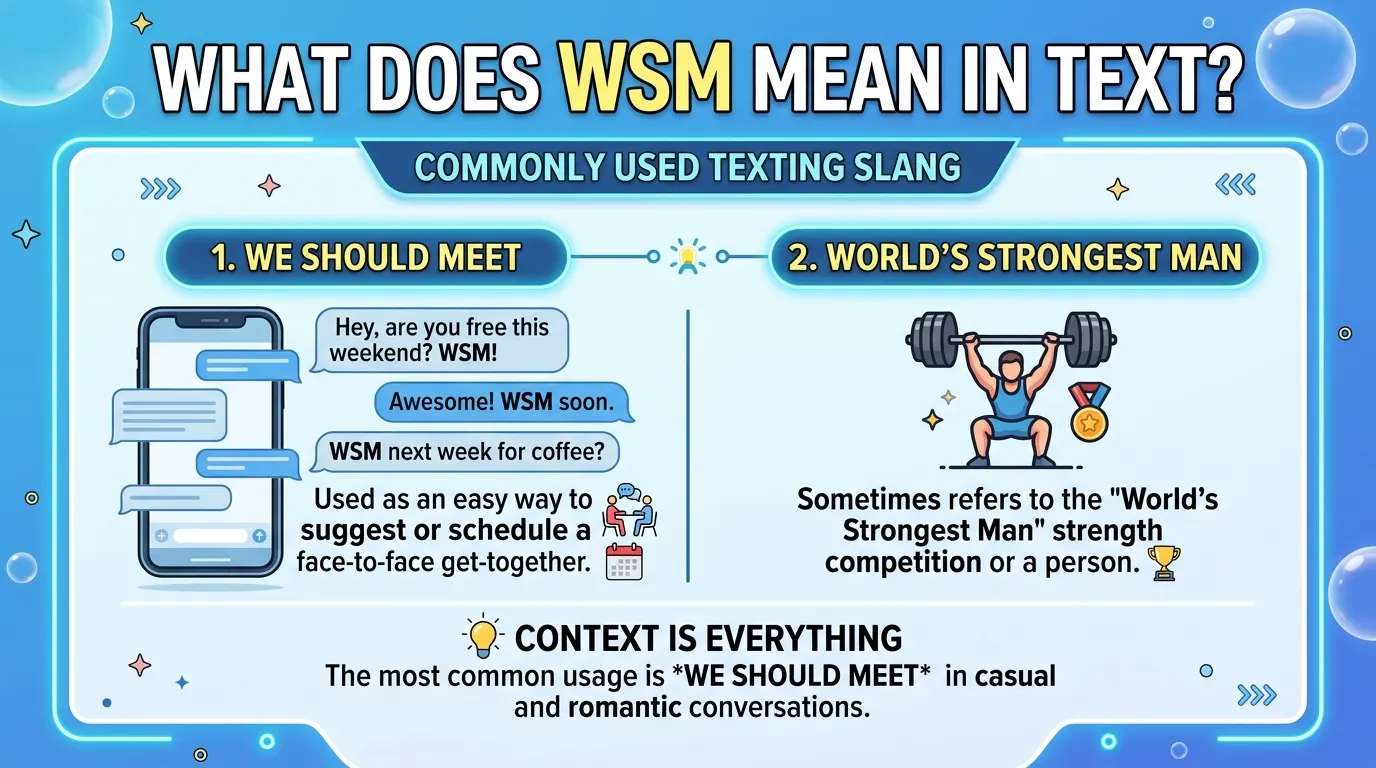
Have you ever received a message saying “WSM” and wondered what it means? In most text conversations, WSM commonly stands for “What’s Up, Man?” or “What’s the Matter?”, depending on the context. You’ll often see it on TikTok, Snapchat, Instagram, WhatsApp, and in everyday texting, which is why many people search for its meaning.
Internet slang changes quickly, and the same abbreviation can have more than one meaning. That can make simple conversations confusing, especially if you’re new to texting abbreviations or social media slang.
The good news is that understanding WSM is easier than it seems. Once you know the context, you’ll usually be able to tell exactly what someone means and reply naturally.
In this guide, you’ll learn the real meaning of WSM, where people use it, how it appears on different social media platforms, and how to understand it in everyday conversations.
WSM Meaning in Text
The abbreviation WSM is an internet acronym used in text messages and online chats. Like many texting abbreviations, its meaning depends on the conversation.
The most common meanings include:
- What’s Up, Man?
- What’s the Matter?
Less commonly, WSM may have other meanings in specific communities or industries, but in casual texting these two definitions are the most widely used.
WSM = “What’s Up, Man?”
This is the meaning you’ll see most often among friends.
It’s simply a casual greeting, similar to saying:
- What’s up?
- How are you?
- What’s going on?
- Hey, what’s new?
For example:
Alex: WSM bro?
Ryan: Nothing much, just watching a movie.
In this conversation, WSM is simply a friendly way to start chatting.
WSM = “What’s the Matter?”
Sometimes WSM is used when someone notices that another person seems upset or quiet.
Example:
Emma: You’ve been quiet today.
Lily: Yeah…
Emma: WSM?
Here, WSM means “What’s the matter?” and shows concern rather than greeting someone.
Is WSM Slang?
Yes. WSM is considered internet slang because it is an informal abbreviation commonly used in online conversations.
It is also an acronym since each letter represents the first letter of a word.
People use WSM because it’s quicker to type than writing the full phrase, especially during fast conversations.
Why Do People Use WSM?
There are several reasons why WSM has become popular:
- It saves time while typing.
- It feels casual and friendly.
- It fits naturally into quick chats.
- It’s widely understood by younger internet users.
- It works across multiple social media platforms.
As texting has become faster, abbreviations like WSM have become part of everyday digital communication.
Does WSM Always Mean the Same Thing?
No.
Like many internet abbreviations, WSM depends on context.
For example:
Friend sends: “WSM bro?”
This almost certainly means:
“What’s up, man?”
But if someone says:
“You don’t look okay. WSM?”
The meaning changes to:
“What’s the matter?”
Reading the surrounding messages usually makes the intended meaning clear.
Where People Use WSM
You’ll find WSM across many messaging apps and social platforms. Although the meaning stays similar, the way people use it can vary depending on where the conversation takes place.
WSM on TikTok
TikTok users often include WSM in comments, captions, and direct messages.
Creators or viewers may use it to greet friends or ask what’s happening.
Examples:
- WSM everyone?
- WSM tonight?
- WSM bro 😂
Because TikTok comments are short and fast-moving, abbreviations like WSM help users communicate quickly.
WSM on Snapchat
Snapchat is one of the most common places where WSM appears.
Friends often send snaps with messages like:
- WSM?
- WSM dude?
- WSM tonight?
It’s usually just another way of asking what someone is doing or how they’re feeling.
WSM on Instagram
On Instagram, WSM is commonly seen in:
- Direct Messages (DMs)
- Story replies
- Comments
- Group chats
Someone might reply to your story with:
WSM?
They’re simply trying to start a conversation.
You’ll also see messages such as:
- WSM this weekend?
- WSM lately?
- WSM my guy?
WSM on WhatsApp
WhatsApp conversations are usually between friends, classmates, coworkers, or family members.
People often use WSM when checking in with someone.
Examples include:
- WSM?
- WSM today?
- WSM after work?
Because WhatsApp is designed for quick messaging, short acronyms like WSM are very common.
WSM in SMS Text Messages
Even traditional SMS texting still uses abbreviations like WSM.
Instead of typing a full sentence, someone may simply send:
WSM?
Depending on the conversation, they’re asking either:
- “What’s up, man?”
- “What’s the matter?”
This makes texting faster while still keeping the conversation friendly and natural.
Why WSM Is Popular Across Social Media
The popularity of WSM comes down to simplicity. People want quick, easy ways to start conversations without typing long messages.
Whether you’re chatting on TikTok, Snapchat, Instagram, WhatsApp, or through regular text messages, WSM serves as a fast and informal conversation starter. Its flexibility allows it to fit many situations, from greeting a friend to checking on someone who seems upset.
As internet slang continues to evolve, abbreviations like WSM remain popular because they’re short, memorable, and easy to understand once you know the context.
Real Chat Examples
One of the easiest ways to understand WSM is by seeing it in real conversations. The examples below show how people naturally use the abbreviation in different situations. Notice how the meaning changes depending on the context.
Example 1
A: WSM bro?
B: Not much, just got home from work.
A: Nice! Want to play some games later?
Example 2
A: Hey, you’ve been quiet today. WSM?
B: Just feeling a little stressed.
A: Hope everything gets better soon.
Example 3
A: WSM this weekend?
B: I’m going camping with my cousins.
A: Sounds like fun!
Example 4
A: WSM?
B: Just scrolling through TikTok.
A: Same here. Any good videos?
Example 5
A: WSM tonight?
B: Movie night with the family.
A: Enjoy!
Example 6
A: You didn’t reply yesterday. WSM?
B: Sorry! My phone battery died.
A: That explains it.
Example 7
A: WSM man?
B: Studying for tomorrow’s exam.
A: Good luck you’ve got this!
Example 8
A: WSM after school?
B: Going to the gym.
A: Mind if I join?
Example 9
A: WSM everyone?
B: We’re waiting for the livestream to begin.
A: Same here!
Example 10
A: WSM?
B: Nothing much. What’s up with you?
A: Just checking in.
How to Reply When Someone Says “WSM”
If someone sends you a WSM, your reply depends on what they mean. Most of the time, they’re either greeting you or asking if something is wrong.
Here are some natural responses.
Funny Replies
- Just trying to survive Monday. 😂
- Winning at absolutely nothing today.
- Same old chaos!
- Living my best lazy life.
- Just waiting for the weekend.
Casual Replies
- Not much, you?
- Just relaxing.
- Watching YouTube.
- Doing homework.
- Nothing special.
Friendly Replies
- Hey! I’m doing well. How about you?
- Just hanging out with friends.
- Pretty good. What’s new with you?
- Everything’s going great today.
- Thanks for checking in!
Neutral Replies
- I’m busy right now.
- Nothing important.
- Just working.
- Everything is fine.
- I’ll message you later.
Tips for Replying Naturally
A simple answer is usually enough. If WSM means “What’s Up, Man?”, reply with what you’re doing or ask the question back.
If it means “What’s the Matter?”, you can briefly explain how you’re feeling or let the other person know everything is okay.
Is WSM Rude or Offensive?
No. WSM is generally not considered rude or offensive. It’s a casual internet abbreviation used among friends, classmates, and online communities.
In most conversations, people use it as a friendly greeting or to check on someone.
Is It Safe to Use?
Yes. WSM is safe to use in casual conversations, including:
- Text messages
- Social media chats
- Group chats
- Gaming communities
- Conversations with friends
Most people will understand it if they’re familiar with internet slang.
Should You Use It at School?
It depends on the situation.
When chatting with classmates or friends, WSM is perfectly acceptable. However, when communicating with teachers or school staff, it’s better to use complete words and a more professional tone.
For example, instead of writing:
WSM?
You could write:
Hi! How are you today?
Should You Use It at Work?
In professional workplaces, abbreviations like WSM are usually avoided.
If you’re messaging a close coworker informally, it may be fine. But when speaking with managers, clients, or business contacts, using full sentences creates a more professional impression.
When Should You Avoid Using WSM?
Avoid using WSM when:
- Writing formal emails
- Talking to teachers or professors
- Communicating with customers
- Sending business messages
- Speaking in official workplace chats
Choosing the right language for the situation helps prevent misunderstandings.
Who Uses This Term?
WSM is mainly used by people who frequently communicate online through texting and social media.
Although anyone can use it, it’s especially common among younger internet users.
Gen Z Usage
Gen Z has helped popularize abbreviations like WSM.
Because this generation spends a lot of time on messaging apps, short acronyms have become a natural part of everyday conversations.
Instead of typing long greetings, many simply write:
- WSM?
- WYD?
- HBU?
- IMO
This keeps conversations quick and casual.
Teenagers and Young Adults
Teenagers and people in their twenties are the most frequent users of WSM.
You’ll often see it in conversations about:
- School
- Friends
- Gaming
- Sports
- Entertainment
- Daily life
Older adults who regularly use social media may also understand and use the term.
Common Platforms
WSM appears most often on:
- TikTok
- Snapchat
- Facebook Messenger
- Discord
- SMS text messages
Gaming communities and group chats also use it as a quick conversation starter.
How Popular Is WSM?
While WSM isn’t as common as abbreviations like LOL, BRB, or IDK, it still appears regularly in casual online conversations.
Its popularity continues because it’s short, easy to type, and works well as both a greeting and a way to check on someone.
Origin of the Term
Like many internet abbreviations, WSM developed as online communication became faster.
Instead of typing complete phrases, people began shortening common expressions into easy-to-remember acronyms.
The phrase “What’s Up, Man?” naturally became WSM, while “What’s the Matter?” also fits the same initials. Over time, both meanings started appearing in text messages and online chats.
Internet Culture’s Influence
The rise of smartphones, social media, and instant messaging encouraged users to communicate with fewer words.
Platforms like MSN Messenger, early chat rooms, Facebook Messenger, Snapchat, WhatsApp, and Discord helped spread abbreviations like WSM.
Today, internet slang continues to evolve as users create shorter and faster ways to communicate.
Is the Origin Certain?
There is no single documented source proving exactly when WSM first appeared.
Like many pieces of internet slang, it likely evolved naturally through online communities rather than being invented by one person.
As its use spread across different platforms, people began interpreting it according to the context of each conversation. That’s why WSM can have more than one accepted meaning today.
Comparison Table
Many internet abbreviations look similar, but each has a different purpose. The table below compares WSM with some of the most common texting acronyms.
| Term | Meaning | Type | Common Usage | Popularity |
| WSM | What’s Up, Man? / What’s the Matter? | Acronym | Greeting or checking on someone | Moderate |
| IDK | I Don’t Know | Acronym | Expressing uncertainty | Very High |
| IDC | I Don’t Care | Acronym | Showing indifference | High |
| IMO | In My Opinion | Acronym | Sharing personal opinions | High |
| BRB | Be Right Back | Acronym | Letting someone know you’ll return | Very High |
Although WSM isn’t as widely used as IDK or BRB, it’s still recognized in many texting conversations, especially among younger users and active social media communities.
Real-World Usage Example
Imagine you’ve just posted a new photo on Instagram. A friend sends you a direct message that simply says:
“WSM?”
They’re not criticizing your post or asking a complicated question. In most cases, they’re simply starting a conversation by asking, “What’s up, man?” or “What’s going on?”
Here’s another example.
After school, one of your classmates notices you’ve seemed unusually quiet all day and sends:
“Hey, WSM?”
In this situation, the meaning changes to “What’s the matter?” They want to know if you’re okay and are checking in because they care.
These examples show why context is important. The same abbreviation can have different meanings depending on the conversation.
FAQs:
What does WSM mean in text messages?
In text messages, WSM usually means “What’s Up, Man?” as a casual greeting or “What’s the Matter?” when asking if someone is okay. The correct meaning depends on the conversation.
What does WSM mean on TikTok?
On TikTok, WSM is commonly used in comments, captions, and direct messages to start conversations or ask what someone is doing. It has the same meaning as in regular texting.
Is WSM slang?
Yes. WSM is an internet slang acronym used in casual online conversations. It’s popular in texting, gaming, and social media because it’s quick and easy to type.
Is WSM rude or offensive?
No. WSM is generally considered friendly and harmless. It isn’t offensive, but it’s best reserved for informal conversations rather than professional or academic communication.
How should you reply to WSM?
Reply naturally based on the context. If someone means “What’s Up, Man?”, you can answer with what you’re doing or ask the question back. If they mean “What’s the Matter?”, simply explain how you’re feeling if you’re comfortable sharing.
Final Thoughts:
If you’ve been wondering what WSM means in text, the answer is simple: it usually stands for “What’s Up, Man?” or “What’s the Matter?” Depending on the conversation, it can be either a friendly greeting or a caring way to check on someone.
You’ll often see WSM on TikTok, Snapchat, Instagram, WhatsApp, Discord, and in everyday text messages. While it isn’t one of the most common internet abbreviations, it’s still widely understood by people who regularly use social media and messaging apps.
The key to understanding WSM is paying attention to the context. A quick look at the surrounding messages will usually tell you which meaning the sender intended. Once you know that, responding becomes easy and natural.
As internet slang continues to evolve, learning abbreviations like WSM helps you communicate more confidently online. Whether you’re chatting with friends, replying to social media messages, or exploring the latest texting trends, understanding terms like WSM makes digital conversations much easier to follow.

Michael Anderson is a Bible researcher and Christian writer who simplifies Scripture for everyday readers. At meanspaces.com he shares clear and meaningful insights into Bible verses and their spiritual significance.